 Background
The Book of Alma is filled with mention of secret combinations associated with kingmakers and related plots.
I personally find conspiracy theories as boring and pointless as Sherlock from Elementary does. However, a fascination with conspiracy theories is part of the human condition. Nineteenth-century
readers were quite familiar with the so-called Burr conspiracy which
occurred in the century's first decade. It was reported in multiple
newspapers. It was likely the most famous national event of that time.
In sum, Aaron Burr, after he killed Alexander Hamilton, started
gathering supporters to create a country out of the Mississippi Valley.
Within fifty years, the United States would be divided North versus
South. But at the time, the divide was between the Atlantic states and
the states/territories to the West. The perception was that the Eastern
states were run by elite politicians and moneymakers who wanted to rob
farmers and ordinary people of their goods and money and land, a
perception that was fueled, in part, by the Whiskey Rebellion (and yes,
that perception lingers).
Burr's
rhetoric and his behavior (which may have been part of a kind of Ponzi
scheme) were reported--in part by people who claimed to have joined the
conspiracy (see Sherlock's point above). And he was ultimately found not
guilty since his behavior seems to have fallen into blustering
bombastic populist egotistic self-flattery that didn't result in any
actual violent military action. He did leave the United States after his
trial, however.
It
is entirely a matter of speculation whether the average citizen, for whom Burr
claimed to be acting, would have favored Burr in the long run any more
than any other high-handed self-appointed autocrat. The Book of Mormon,
for one, pairs elitism with local kingmakers. Captain Moroni
heads to the country's capital to restore the government there, an act
that many nineteenth-century readers would have endorsed. (In 1814, the
Burning of Washington resulted in the president being temporarily ousted
from the capital.)
In other words, the Federal government was perceived by many
groups, including what became the Mormons, as a necessary check to what
James Madison called "the spirit of locality," that is, the bullying
that can occur in a pure democracy (the inevitable bullying here is why
the electoral college is still a decent form of democracy). The attitude
of the Federal government at that time, however, was to restrict
Federal involvement, as demonstrated in Barron v. Baltimore, in which a
property owner's loss of income was not (fully) redressed despite the
state violating the owner's rights; the Supreme Court determined that
the problem was between the owner and the state. The issue wasn't a
Federal one.
The
problem of rights and the individual is complex and indicates
that libertarianism is not automatically a state v. Federal issue, at
least not historically. Utah Mormons would later have a fraught
relationship with the Feds. Some of the seeds of distrust were sown in
the Nauvoo years when petitions for Federal protection against state
harassment were, from the view of Joseph Smith and his followers,
ignored.
That disillusionment was to come. Early readers of The Book of
Mormon would have encountered a more optimistic solution in The Book of
Mormon's Captain Moroni. And it is notable that despite the time
period's Millennial fever, many low to middleclass Americans were not
interested in revolutions of the messy kind (however proud they were of
their own revolution) but, rather, in balanced and rational governments
so they could get on with life.
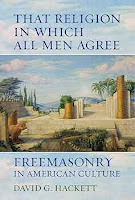 |
I highly recommend!
|
Freemasonry & Themes in The Book of Mormon
Any discussion of Mormons and conspiracies brings up freemasonry.
Nineteenth-century Mormons, including Joseph Smith, were well-aware of the inherent tension of freemasonry.
On the one hand was the desire for secret or gnostic knowledge
separate from philosophical, "educated" theoretical blatherings amongst
Eastern elites. Freemasonry returned rituals to Protestantism as well as
the mysticism and active participation that not only the Enlightenment
but late Calvinism seemed to be wiping out (aside from revivals, of course, but even revivals maintained a kind of top-down expectation of "correct" performance--see "confessions" on modern social media). The desire for knowledge and
ritual is arguably a human one. Freemasonry likely mirrors the Ancient
Roman soldier's interest in Mithraism. Like the Ancient Roman soldier,
many non-educated (and educated) Americans wanted something real and
powerful and non-labelly yet profound--something other than country club
religion (which frankly, Ancient Roman paganism rather resembled for
the elite).
Freemasonry appeared to
deliver. (It also filled a gap in American culture as church and state
increasingly separated after the American Revolution.)
And yet, on the other side, was an intense dislike of
secret societies, which dislike often expanded to include a dislike of
elites making backroom deals at the expense of the "common man" (see above).
In the early 1800s, the "common" citizen was a farmer while Masons were
often merchants and professionals. Not wealthy earners from our modern
point of view. But not "common" enough. (However, that image is
complicated by the sheer number of social organizations, freemasonry and otherwise, within the United States at the time.)
The tensions here resided in Gothicism, which began in the
eighteenth century, and go a long way to explaining the popularity of Ann Radcliffe oeuvre and Stoker's Dracula.
On the one hand was a yearning for the ritualistic, knightly Catholic past, including its buildings and Saints and priests.
On the other was a dislike of Catholic doctrine (as understood by Protestants).
On the one hand was a desire for supernatural romanticism, elements
of the human experience that the carefully constructed arguments of
Protestantism and the Enlightenment seemed to be eliminating.
On the other was a paranoid dislike of secrecy and stuff happening behind closed doors (see pamphlets about Maria Monk).
So, on the one hand, The Book of Mormon promises that more
mysteries are forthcoming. On the other, it contains an ongoing worry
about conspiring groups.
The text continually marks the difference: namely, positive
communities want to expand rights while negative societies want to
remove them. The problem is arguably more difficult. But the
characterizations remain consistent within the text.
The
problem, eventually, in Nauvoo, was that Joseph Smith perceived
polygamy and its rational outgrowth, temple ceremonies, as
positives that joined more and more members together--while others saw
such things as violations of basic Christianity and therefore, negative
and destructive (and secretive) influences.
I am reminded of a scene in That Hideous Strength in which
the main character, Mark, who has always wanted to be in "the know" of a
secret society doesn't even recognize when he becomes part of one with
the ragged beggar man.
C.S. Lewis returns here to an idea that he raises in Surprised by Joy.
He paints in an entirely positive light the boys' secret brotherhood at
the worst private school he attended. Yet the later "in-group"
mentality of intellectuals and poseurs and social climbers, he paints
wholly negatively. The first group didn't set out to be a society. The
boys were merely trying to survive and helped each other out ("we few,
we happy few"). The second group, however, could only exist if "outsiders" were torn down; they couldn't advance unless others were put in their
place.
As definitions--society that joins people together through ties of
fellowship is good; society that bands together to mock and find things
wrong with others is bad--these are quite usable even if the events to
which they are applied can be quite complex. Such definitions appear in
The Book of Mormon over and over again.
Regarding
freemasonry and the temple, Joseph Smith borrowed from whatever was to
hand--as did lots of people. Like with most human institutions, one monolithic
freemasonry organization didn't exist in the United States, especially
since women, Native Americans, Jews, and Blacks created their own
lodges.
"Borrowing"--even appropriation--is not the same as a
conspiracy.
 I
am troubled by how little people seem to know--or
care--about history and context. Our current social climate encourages
partakers of online media to develop stories about other people and
about the past without questioning those stories or learning more. Checks against the resulting imposed narratives--"Is that
really within your purview?" "Do you have enough information?"
"Shouldn't you find out more first?"--are bypassed to deliver
(supposedly caring, well-intentioned, emotionally justified and allegedly righteous) verdicts of others. Those verdicts often include labels, which labels appear to align with what I call "first
cause," a modern-day version of original sin:
I
am troubled by how little people seem to know--or
care--about history and context. Our current social climate encourages
partakers of online media to develop stories about other people and
about the past without questioning those stories or learning more. Checks against the resulting imposed narratives--"Is that
really within your purview?" "Do you have enough information?"
"Shouldn't you find out more first?"--are bypassed to deliver
(supposedly caring, well-intentioned, emotionally justified and allegedly righteous) verdicts of others. Those verdicts often include labels, which labels appear to align with what I call "first
cause," a modern-day version of original sin: 


